Beyond the Lab: Why -40°C to +75°C Endurance Testing is Mandatory for RV Roof Lift Systems
For an RV manufacturer or a specialist converter, the "laboratory" isn't the final judge of quality—the real world is. From the frost-heavy winters of Scandinavia and Canada to the blistering desert heat of the Australian Outback, your customers rely on automation to work every single time.
When an electric roof lift fails due to temperature-induced stress, it doesn't just ruin a camping trip; it damages your brand’s reputation for reliability.
Temperature extremes aren't just uncomfortable; they change the physical behavior of mechanical systems.
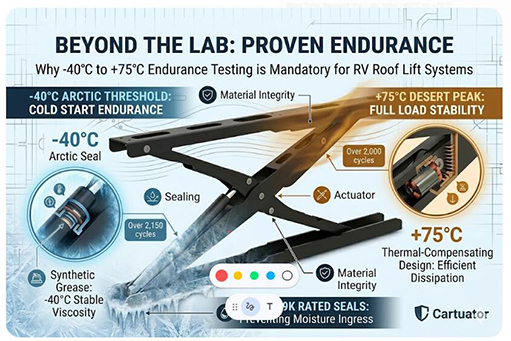
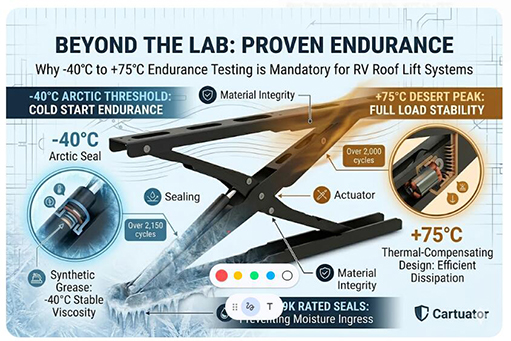
At -40°C (The Arctic Threshold): Standard lubricants can become as viscous as molasses, increasing internal friction. Seals can turn brittle, and motors face massive startup loads that can trigger over-current protection.
At +75°C (The Desert Peak): High ambient heat combined with the thermal output of a working motor can push electronic controllers into "safe mode," or worse, lead to permanent component degradation.
| (No.) | (Environmental Reliability Test) | (Standard Requirements) | (Test Results) | (Verdict) |
| 1 | Low-Temperature Operational Test | Place sample in chamber at -40°C. Perform continuous lift cycles. Log status every 24h. Return to room temp. Sample must function normally. | Sample operated normally for approx. 2150 cycles. Resumed operation smoothly after returning to room temp. | Pass |
| 2 | High-Temperature Operational Test | Place sample in chamber at +75°C. Perform 2000 continuous lift cycles. Log status every 24h. Return to room temp. Sample must function normally. | Sample operated normally throughout the test. | Pas |
At Cartuator, we believe in validation, not just speculation. We recently subjected our Flat-top Lift System (RV Pop-up Roof) to a rigorous high-and-low temperature operational cycle test.
The Test Protocol:
Low-Temperature Endurance: Stabilized at -40°C, the system performed approximately 2,150 continuous lift cycles.
High-Temperature Stress: Stabilized at +75°C, the system underwent 2,000 continuous lift cycles.
Functional Integrity: After returning to room temperature, a full system diagnostic was performed to ensure zero structural or electronic drift.
The Verdict:The system passed with a (Compliant/Pass) rating. There was no loss of synchronization, no seal failure, and the startup response remained consistent across the entire thermal spectrum.
How do we achieve these results? It’s a combination of four core engineering pillars:
Aerospace-Grade Lubrication: We use synthetic greases that maintain stable viscosity even at -40°C.
Thermal-Compensating Motors: Our actuators are designed to dissipate heat efficiently, preventing internal buildup during heavy-duty summer use.
Advanced Sealing (IP67/IP69K): Our seals are tested to remain elastic in deep freezes, preventing moisture ingress that causes internal icing.
Smart Control Logic: The "Cartuator" brain adjusts torque output to compensate for environmental resistance without overstressing the hardware.
For our OEM partners, these test results translate into three tangible business advantages:
Reduced Warranty Claims: Build with confidence, knowing the environment won't cause premature failure.
Global Market Access: Whether your market is Northern Europe or the Middle East, our hardware is ready.
Technical Credibility: We provide the Full Test Report and CAD Data to support your engineering team during the design phase.
In the RV industry, "functional" is the baseline, but "reliable" is the competitive edge. At Cartuator, we don't just build systems that lift; we build systems that endure.
Ready to integrate field-proven automation into your next project?